Health note: This article is for general educational purposes and is not medical advice. Talk with your doctor or another qualified health professional about your own situation, especially if you have a medical condition or take medication.
Starting strength training after 40 can feel intimidating, especially if you have never lifted weights or have been away from exercise for years. But this is exactly the stage of life when strength training may matter most. Muscle mass and strength tend to decline gradually with age if they are not used, and that decline can affect balance, metabolism, joint health, and the ability to do everyday tasks with ease. Regular resistance training can help slow or even reverse some of that decline.
This guide gives you a simple, safe, and realistic beginner plan, explains the key principles behind it, and shows you how to progress without getting hurt.
Why Strength Training Matters After 40
- Preserves muscle: Resistance exercise is one of the most effective ways to maintain and build muscle at any age.
- Supports bones: Weight-bearing and resistance exercise can help maintain bone density, which is especially relevant for women after menopause.
- Improves balance and function: Stronger legs and core make it easier to climb stairs, carry groceries, and get up from the floor, and may help reduce fall risk.
- Helps metabolic health: Muscle uses glucose, and strength training can improve insulin sensitivity. See our guide to type 2 diabetes prevention.
- Supports mood and sleep: Many people find regular exercise improves energy and sleep quality.
Public health guidelines recommend that adults do muscle-strengthening activities involving all major muscle groups on two or more days per week, in addition to aerobic activity.
Before You Start
If you have heart disease, high blood pressure, diabetes, joint problems, a recent injury or surgery, or you have been inactive for a long time, check with your doctor before starting. A physical therapist can also help if you have pain or mobility limitations.
What you need
- Comfortable clothes and supportive shoes.
- A sturdy chair, a mat, and some open floor space.
- Optional: a set of light-to-moderate dumbbells or adjustable dumbbells, and resistance bands.
A gym is helpful but not necessary. Many effective exercises use just your body weight.
Key Principles for Beginners
Start lighter than you think
Choose a weight or variation that lets you complete all repetitions with good form and feel like you could do two or three more. This builds confidence and lets your joints and connective tissues adapt.
Focus on form
Move slowly and with control, especially when lowering the weight. Keep a neutral spine and avoid jerking or swinging. Mirrors, videos of yourself, or a session with a qualified trainer can help.
Progress gradually
Once an exercise feels easy for all sets, add a couple of repetitions, then a small amount of weight, or move to a harder variation. Small steps over weeks add up.
Rest and recover
Muscles adapt between workouts. For full-body routines, leave at least one rest day between sessions. Sleep, protein, and hydration support recovery.
Warm-Up (5–10 Minutes)
- March in place or walk briskly for a few minutes.
- Arm circles forward and backward.
- Hip circles and gentle leg swings, holding a wall for balance.
- A few slow bodyweight squats to a chair.
The Beginner Plan: Two or Three Full-Body Sessions per Week
Do the following exercises two or three times per week on non-consecutive days, such as Monday, Wednesday, and Friday. Start with one or two sets of 8 to 12 repetitions for each exercise and rest about one to two minutes between sets.
1. Sit-to-stand (chair squat)
Stand in front of a sturdy chair, feet about hip-width apart. Push your hips back and lower until you lightly touch the chair, then stand up by pressing through your heels. Progress by holding a dumbbell at your chest or lowering without touching the chair.
2. Wall or incline push-up
Place your hands on a wall or kitchen counter, step back, and lower your chest toward it with a straight body, then push away. Progress by using a lower surface, such as a sturdy bench, and eventually the floor.
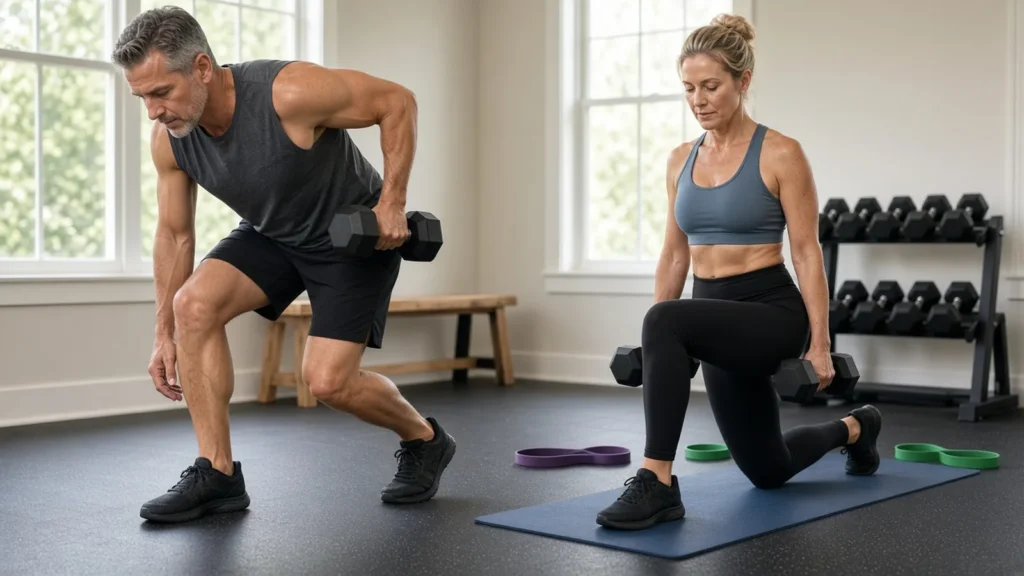
3. One-arm dumbbell row
Place one hand and knee on a bench or sturdy chair, keep your back flat, and pull a dumbbell toward your hip, then lower slowly. This strengthens the upper back and helps posture.
4. Glute bridge
Lie on your back with knees bent and feet flat. Squeeze your glutes and lift your hips until your body forms a straight line from shoulders to knees, then lower. Progress by pausing at the top or doing single-leg bridges.
5. Overhead press (seated or standing)
Hold light dumbbells at shoulder height and press them overhead without arching your lower back, then lower with control. If overhead movement bothers your shoulders, try a front raise or a band press instead.
6. Step-ups
Step onto a low, stable step with one foot, stand up fully, then step down with control. Use a railing for balance at first. This builds leg strength and balance.
7. Dead bug or bird dog
For core stability, try the bird dog: on hands and knees, extend the opposite arm and leg while keeping your back flat, then switch. Or try the dead bug on your back, slowly lowering opposite arm and leg while pressing your lower back gently into the floor.
8. Farmer’s carry
Hold a dumbbell or heavy bag in each hand and walk tall for 20 to 30 seconds. This strengthens grip, core, and posture.
Cool-Down and Mobility
Finish with a few minutes of easy walking and gentle stretches for your chest, hips, hamstrings, and calves. Hold each stretch comfortably without bouncing.
A Sample 8-Week Progression
- Weeks 1–2: Two sessions per week, one set of each exercise, focusing on form.
- Weeks 3–4: Two or three sessions per week, two sets per exercise.
- Weeks 5–6: Increase repetitions toward 12, then add a little weight or a harder variation.
- Weeks 7–8: Consider three sets of key exercises and add one new movement, such as a lunge or band pull-apart.
Common Mistakes to Avoid
- Doing too much too soon: Excessive soreness or joint pain can derail your motivation.
- Holding your breath: Breathe out during the effort and in as you lower.
- Ignoring pain: Muscle fatigue is normal; sharp or joint pain is a signal to stop and seek advice.
- Skipping legs: Lower-body strength is crucial for daily function and balance.
- Being inconsistent: Two sessions every week beat five sessions one week and none the next.
Supporting Habits
Protein and nutrition
Muscles need adequate protein to recover and grow. Include a source of protein, such as fish, poultry, eggs, dairy, beans, lentils, or tofu, at each meal. If you have kidney disease or other conditions, ask your doctor or a dietitian about appropriate intake. Our guide to heart-healthy eating on a budget includes affordable protein ideas.
Aerobic activity
Combine strength training with regular walking or other cardio for overall health. See walking for health.
Sleep
Recovery happens largely during rest. A good routine helps; read how to build a sleep routine.
Frequently Asked Questions
Is it too late to start strength training at 50 or 60?
No. Research has shown that people can gain strength well into older age when they train appropriately. Start gently and progress gradually.
Will lifting weights make me bulky?
Most people, especially beginners, gain strength and some muscle tone rather than large bulk. Building large muscles requires specific, intense training and nutrition over a long time.
How long until I see results?
Many beginners notice they feel stronger within a few weeks, partly because the nervous system learns movements quickly. Visible changes typically take longer.
Should I train if I’m sore?
Mild soreness is common early on. Light activity may help. If soreness is severe or you feel joint pain, rest and consider adjusting your program.
Conclusion
Strength training after 40 is one of the best investments you can make in your long-term health and independence. Start with simple full-body sessions two or three times a week, prioritize good form, increase the challenge gradually, and support your training with protein, sleep, and regular movement. With consistency, you can feel stronger, steadier, and more capable in daily life.