Risk warning: Trading foreign exchange (forex) and CFDs on margin carries a high level of risk and may not be suitable for all investors. Leverage can work against you as well as for you, and you can lose more than you expect, in some cases more than your initial deposit. This article is for educational purposes only and is not financial or investment advice. Consider your objectives, experience, and risk tolerance, and seek advice from an independent, licensed financial professional if needed.
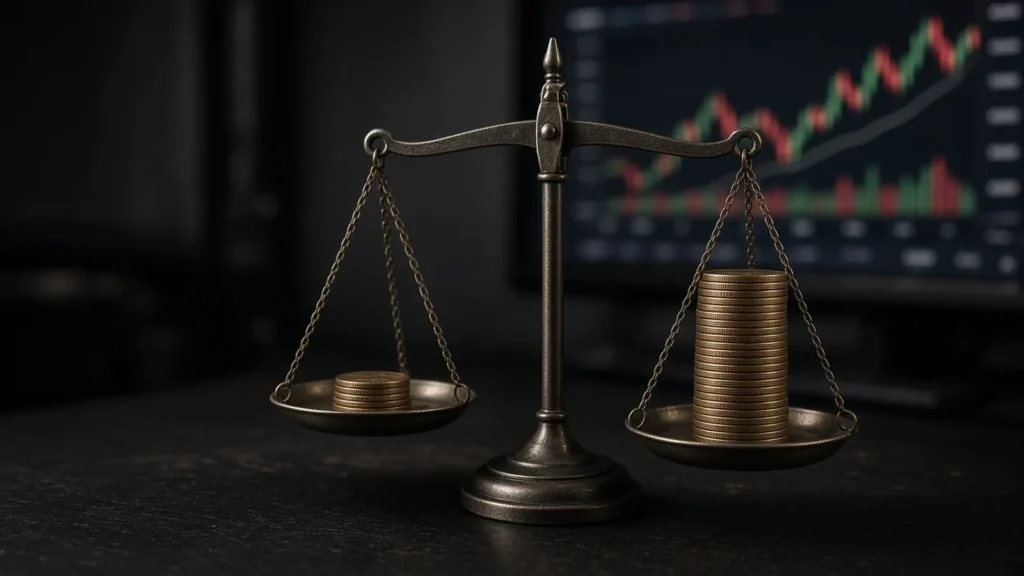
Leverage and margin are two of the most important, and most misunderstood, concepts in forex trading. Leverage allows traders to control positions much larger than their account balance, which is why forex is often marketed as accessible with small deposits. But leverage cuts both ways: the same mechanism that magnifies potential gains magnifies losses, and it’s a major reason many retail traders lose money. Understanding exactly how leverage and margin work is essential before you place a single live trade.
This guide explains leverage, margin, margin calls, and stop-outs with simple examples, and shows how to manage leverage responsibly.
What Is Leverage?
Leverage is the use of borrowed capital to increase the size of a trading position. In forex, brokers provide leverage expressed as a ratio, such as 30:1 or 50:1. A 30:1 leverage ratio means that for every 1 unit of your own money used as margin, you can control a position worth 30 units.
For example, with 30:1 leverage, a position worth 30,000 units of currency requires about 1,000 units of margin. The full value of the position determines your profit or loss, not just the margin you put up.
What Is Margin?
Margin is the amount of money required in your account to open and maintain a leveraged position. It’s not a fee; it’s a portion of your account set aside as collateral. Key margin terms include:
- Required (used) margin: The amount locked to keep your open positions.
- Equity: Your account balance plus or minus unrealized profits and losses.
- Free margin: Equity minus used margin; the amount available to open new positions or absorb losses.
- Margin level: Equity divided by used margin, expressed as a percentage. Brokers use it to determine margin calls and stop-outs.
Margin requirement and leverage are two sides of the same coin
A margin requirement of about 3.33% corresponds to roughly 30:1 leverage; a 2% requirement corresponds to 50:1; a 5% requirement corresponds to 20:1.
A Simple Example
Suppose you have an account of 2,000 dollars and open a position of 10,000 units in EUR/USD (a mini lot). At a price of 1.1000, the position’s notional value is about 11,000 dollars. With a 3.33% margin requirement, required margin is about 367 dollars.
- For a mini lot, each pip is worth about 1 dollar for EUR/USD.
- If the price moves 50 pips in your favor, you gain about 50 dollars, roughly 2.5% of your account.
- If it moves 50 pips against you, you lose about 50 dollars.
Now suppose you instead open a much larger position using most of your available margin, say 50,000 units. Each pip is worth about 5 dollars. A 100-pip move against you would cost about 500 dollars, or 25% of your account. Price moves of that size can happen over days, or quickly during major news. This illustrates why the amount of leverage you actually use matters more than the maximum your broker offers.
Effective Leverage: The Number That Really Matters
Your effective leverage is the total value of your open positions divided by your account equity. Even if your broker offers 30:1, you can choose to use much less. In the example above, an 11,000-dollar position on a 2,000-dollar account is effective leverage of about 5.5:1, while a 55,000-dollar position is about 27.5:1. Many experienced traders keep effective leverage low and focus on risk per trade; see forex position sizing.
Margin Calls and Stop-Outs
Margin call
When losses reduce your equity so that your margin level falls to a threshold set by your broker, you may receive a margin call, a warning that you need to add funds or reduce positions.
Stop-out
If the margin level falls further to the stop-out level, the broker may automatically close some or all of your positions, typically starting with the largest losing position, to prevent further losses. This can lock in substantial losses at unfavorable prices.
Negative balance
In fast markets, prices can gap past stop levels, causing losses greater than your account balance. Some regulators require brokers to provide negative balance protection for retail clients, but this isn’t universal. Check your broker’s policy.
Regulatory Leverage Limits
Many regulators cap leverage for retail clients. For example, regulators in the European Union, United Kingdom, and Australia have set maximum leverage limits for retail clients that vary by asset class, with major currency pairs capped at 30:1. In the United States, regulatory limits are 50:1 for major currency pairs and lower for others. Offshore brokers may offer much higher leverage, such as several hundred to one, often with weaker client protections. High leverage availability is not a benefit if it encourages oversized positions. See how to choose a regulated forex broker.
Why Leverage Leads to Losses
- Oversized positions: Small price moves cause large percentage losses.
- No room for normal volatility: Tight margins force traders out of positions during routine fluctuations.
- Emotional pressure: Large swings in account value lead to impulsive decisions; see forex trading psychology.
- Compounding losses: Recovering from large drawdowns requires much larger percentage gains. A 50% loss requires a 100% gain just to get back to even.
Managing Leverage Responsibly
- Define risk per trade: Many educators suggest risking a small fixed percentage of your account per trade, commonly 1% to 2% or less.
- Use stop-loss orders: Determine your exit before entering; see stop-loss and take-profit orders.
- Calculate position size from risk and stop distance, not from available margin.
- Monitor total exposure: Multiple positions in correlated pairs, such as EUR/USD and GBP/USD, can increase risk.
- Be cautious around news events, when spreads widen and prices can gap; see economic calendar and news.
- Consider lower leverage settings if your broker allows you to choose.
- Keep a buffer of free margin to avoid margin calls during normal fluctuations.
Overnight Costs and Leverage
Holding leveraged positions overnight usually involves swap or rollover charges or credits based on interest rate differences between the two currencies. Because swaps are calculated on the full position size, they can add up over time. Check your broker’s swap rates.
Frequently Asked Questions
Is high leverage good for small accounts?
High leverage allows larger positions, but that increases risk. Small accounts are often better served by small positions and patient growth.
Can I lose more than I deposited?
It’s possible in some circumstances, depending on your broker’s negative balance protection and market conditions.
Does lower leverage reduce profits?
It reduces both potential profits and losses for a given price move. Risk management aims to survive long enough to apply a tested strategy.
How do I check my margin level?
Trading platforms typically display balance, equity, used margin, free margin, and margin level in the account or terminal window.
Conclusion
Leverage lets forex traders control large positions with relatively small deposits, and margin is the collateral that makes it possible. The maximum leverage your broker offers is far less important than the effective leverage you actually use. By sizing positions based on a small risk per trade, using stop-losses, keeping free margin, and understanding margin calls and stop-outs, you can use leverage more responsibly, though risk can never be eliminated.
Risk warning: Trading foreign exchange (forex) and CFDs on margin carries a high level of risk and may not be suitable for all investors. Leverage can work against you as well as for you, and you can lose more than you expect, in some cases more than your initial deposit. This article is for educational purposes only and is not financial or investment advice. Consider your objectives, experience, and risk tolerance, and seek advice from an independent, licensed financial professional if needed.