Risk warning: Trading foreign exchange (forex) and CFDs on margin carries a high level of risk and may not be suitable for all investors. Leverage can work against you as well as for you, and you can lose more than you expect, in some cases more than your initial deposit. This article is for educational purposes only and is not financial or investment advice. Consider your objectives, experience, and risk tolerance, and seek advice from an independent, licensed financial professional if needed.
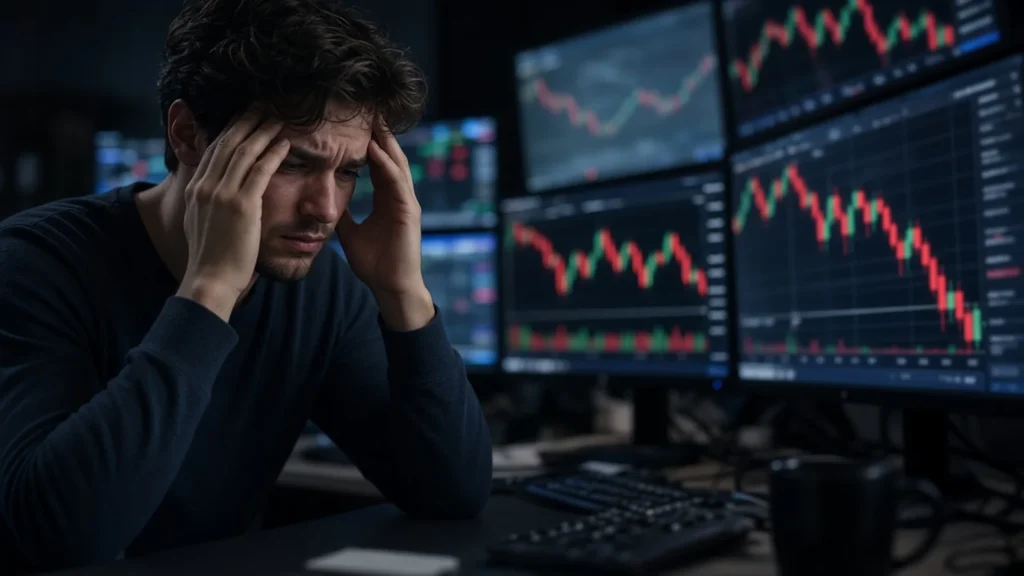
Many traders discover that knowing a strategy isn’t the hard part. Following it consistently is. Fear, greed, frustration, and overconfidence can push even well-prepared traders into decisions they know are unwise: moving a stop-loss, doubling down on a losing trade, or jumping into a setup that doesn’t meet their rules. Trading psychology, the study of how emotions and cognitive biases affect trading decisions, is often what separates disciplined traders from those who repeatedly sabotage themselves.
This guide explores common psychological mistakes in forex trading, why they happen, and practical techniques to manage them.
Why Psychology Matters So Much in Trading
Trading involves uncertainty, real money, and rapid feedback. Every trade can produce a win or loss within minutes or hours, and leveraged positions can cause large swings in account value; see leverage and margin explained. Under these conditions, natural human tendencies, such as avoiding losses, seeking certainty, and reacting to recent events, can lead to poor decisions. Recognizing these tendencies is the first step to managing them.
Common Psychological Mistakes
1. Revenge trading
After a loss, some traders immediately enter another trade, often larger, to “win back” the money. These trades are usually impulsive and outside the trading plan, and can turn a small loss into a large one.
2. Fear of missing out (FOMO)
Seeing a fast-moving market can trigger the urge to jump in without a proper setup, often near the end of the move, with poor entry and stop placement.
3. Moving or removing stop-losses
Loss aversion, the tendency to feel losses more strongly than equivalent gains, can lead traders to widen stops or remove them, hoping price will turn around. This undermines risk management; see stop-loss and take-profit orders.
4. Cutting winners too early
The same loss aversion can make traders grab small profits quickly to avoid seeing gains disappear, while letting losers run. Over time, this creates small wins and large losses.
5. Overtrading
Boredom, excitement, or the belief that more trades mean more profit can lead to excessive trading, higher costs, and lower-quality setups.
6. Overconfidence after a winning streak
A series of wins can lead traders to increase position sizes or loosen their rules, exposing them to large losses when conditions change.
7. Confirmation bias
Traders may seek information that supports their existing view and ignore evidence against it, staying in losing trades too long.
8. Recency bias
Giving too much weight to the most recent trades or market moves, such as abandoning a sound strategy after a few losses.
9. Analysis paralysis
Fear of being wrong can lead to endless analysis and missed planned trades, or adding so many indicators that no clear decision emerges.
10. Gambler’s fallacy
Believing a win is “due” after several losses. Each trade’s outcome is independent of the last in most strategies.
Building a Foundation for Discipline
Write a trading plan
A written plan defines which markets and sessions you trade, entry and exit criteria, risk per trade, maximum daily or weekly loss, and rules for when not to trade. Decisions made in advance, when calm, are more reliable than decisions made in the moment.
Risk small amounts per trade
When each trade risks only a small fraction of your account, individual losses feel less threatening and emotions are easier to manage. See forex position sizing.
Accept losses as part of trading
Even effective strategies produce losing trades and losing streaks. Think in terms of a series of trades rather than any single outcome.
Focus on process, not just profit
Evaluate yourself on whether you followed your plan. A rule-following trade that loses is a good trade; a rule-breaking trade that wins reinforces bad habits.
Practical Techniques
Keep a trading journal
Record each trade’s setup, reasoning, entry, stop, target, result, and your emotional state before and after. Reviewing your journal weekly reveals patterns, such as trading worse after losses or at certain times of day.
Set daily and weekly loss limits
Stop trading for the day after a defined loss amount or number of losing trades. This prevents revenge trading and tilt.
Use checklists
Before entering a trade, run through a checklist: Does this meet my criteria? Have I checked the news calendar? Is my position size correct? See economic calendar and news.
Take breaks
Step away after a big win or loss. Physical activity, such as a short walk, can help reset; see managing stress.
Limit screen time
Watching every tick encourages impulsive decisions. Use alerts and pending orders instead of constant monitoring.
Reduce size after drawdowns
Temporarily trading smaller after a losing streak can reduce pressure while you review what’s happening.
Look after the basics
Sleep, nutrition, and stress levels affect decision-making. Avoid trading when exhausted, ill, or emotionally upset; see how to build a sleep routine.
Recognizing Tilt
“Tilt” describes a state where emotions take over decision-making. Warning signs include increasing position sizes after losses, abandoning your plan, trading outside your usual hours or pairs, and feeling angry or desperate. When you notice these signs, stop trading and step away.
The Role of Practice
Demo trading helps you learn mechanics and test strategies, but it doesn’t fully replicate the emotions of real money. Many traders transition gradually, starting with very small live positions; see demo vs. live trading.
A Simple Pre-Trading Routine
A short routine before each session can put you in a calmer, more deliberate frame of mind. Many traders spend a few minutes reviewing their plan and the day’s economic calendar, checking open positions, and noting their current emotional state on a simple scale. If they feel rushed, angry, or overly excited, they trade smaller or not at all that day. Ending each session with a brief review, such as writing what went well, what didn’t, and one thing to improve, closes the loop and turns every day into a learning opportunity rather than a scoreboard.
Frequently Asked Questions
Can trading psychology be learned?
Yes. Awareness, structured routines, journaling, and experience help most traders improve discipline over time.
Should I trade when I’m stressed?
Generally, it’s better to avoid trading when stressed or upset, as emotions can override judgment.
How do I stop revenge trading?
Set a firm daily loss limit, take a mandatory break after losses, and review losing trades in your journal before trading again.
Is it normal to feel anxious when trading?
Yes. If anxiety is intense, consider reducing position size, trading less, or reassessing whether trading fits your financial situation. Seek professional support if stress affects your wellbeing.
Conclusion
Trading psychology shapes how well you execute any strategy. Common mistakes, such as revenge trading, FOMO, moving stops, overtrading, and overconfidence, stem from natural human tendencies that can be managed with structure: a written plan, small risk per trade, loss limits, checklists, and a trading journal. Focus on following your process, take care of your wellbeing, and remember that no amount of discipline removes market risk, but it can keep you from adding unnecessary risk of your own.
Risk warning: Trading foreign exchange (forex) and CFDs on margin carries a high level of risk and may not be suitable for all investors. Leverage can work against you as well as for you, and you can lose more than you expect, in some cases more than your initial deposit. This article is for educational purposes only and is not financial or investment advice. Consider your objectives, experience, and risk tolerance, and seek advice from an independent, licensed financial professional if needed.