Risk warning: Trading foreign exchange (forex) and CFDs on margin carries a high level of risk and may not be suitable for all investors. Leverage can work against you as well as for you, and you can lose more than you expect, in some cases more than your initial deposit. This article is for educational purposes only and is not financial or investment advice. Consider your objectives, experience, and risk tolerance, and seek advice from an independent, licensed financial professional if needed.
Every trade needs an exit plan. Stop-loss and take-profit orders are the tools traders use to define those exits in advance: one to limit losses if the market moves against you, the other to lock in gains if it moves in your favor. Used well, they turn risk management from a hopeful intention into an automatic rule. Used poorly, such as placing stops too tight, moving them out of fear, or skipping them altogether, they can lead to frustrating losses or large drawdowns.
This guide explains how stop-loss and take-profit orders work, the main ways traders decide where to place them, and common mistakes to avoid.
What Is a Stop-Loss Order?
A stop-loss order instructs your broker to close a position when the price reaches a specified level that’s worse than your entry. For a buy (long) position, the stop-loss sits below the entry price; for a sell (short) position, it sits above.
Important limitation: slippage
A standard stop-loss becomes a market order when triggered, so it’s executed at the next available price. In fast markets or when prices gap, such as after major news or over a weekend, the execution price can be worse than your stop level. Some brokers offer guaranteed stop-loss orders, usually for a fee, which close at your exact price regardless of gaps. Check availability and costs with your broker.
What Is a Take-Profit Order?
A take-profit order closes a position when the price reaches a specified favorable level. For a long position it’s above the entry; for a short position it’s below. Take-profit orders typically execute as limit orders, at your price or better.
Why Use Them?
- Define risk before entering: You know your maximum planned loss per trade.
- Remove emotion: Decisions are made calmly in advance rather than under pressure; see trading psychology.
- Protect against unexpected events when you’re away from the screen.
- Enable position sizing: Stop distance is a key input for calculating trade size; see forex position sizing.
Methods for Placing a Stop-Loss
A good stop-loss is placed where your trade idea is proven wrong, not at an arbitrary distance chosen to limit the dollar loss. Then position size is adjusted so that, if the stop is hit, the loss equals your planned risk.
1. Structure-based stops
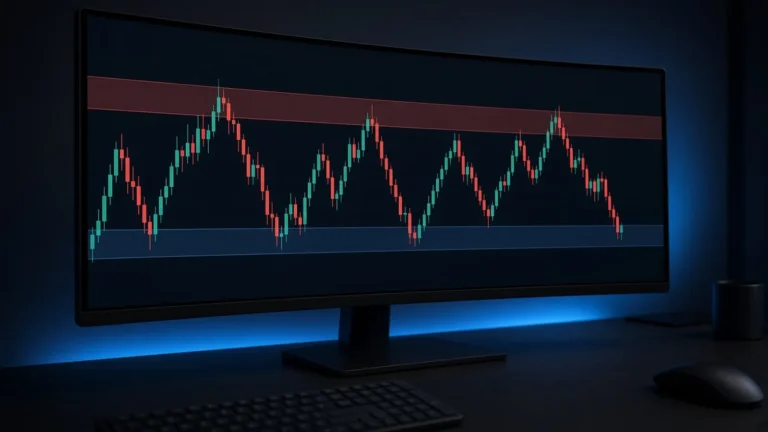
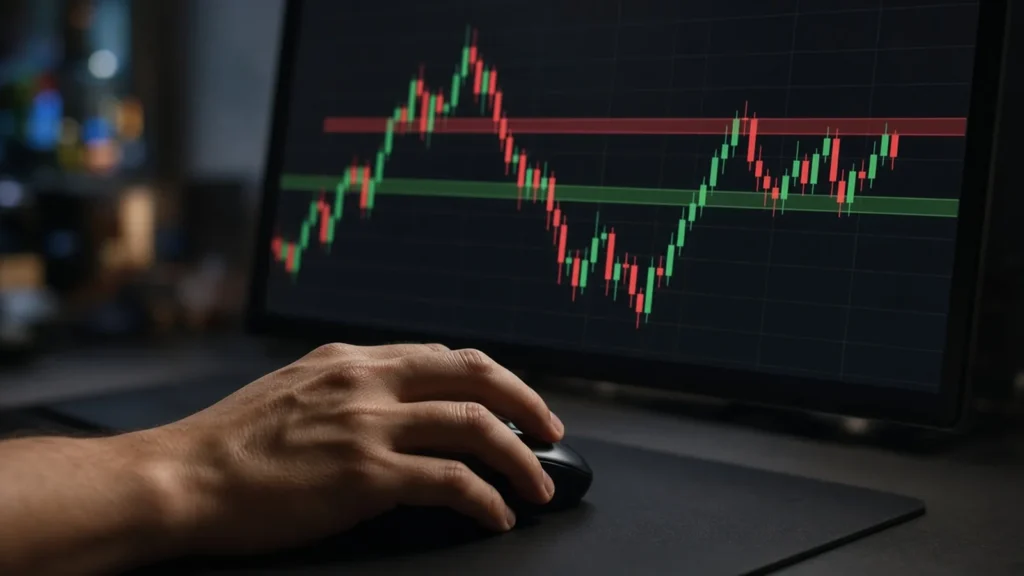
Place stops beyond meaningful price levels: below support for long trades, above resistance for short trades, or beyond recent swing highs and lows. If price breaks through those levels, the original reasoning may no longer hold. See support and resistance: a practical guide.
2. Volatility-based stops
Use a measure of volatility, such as the Average True Range (ATR), to set stops a multiple of typical price movement away from entry. This adapts to changing market conditions: wider stops in volatile markets, tighter stops in calm ones.
3. Indicator-based stops
Some traders place stops beyond moving averages or other indicator levels. As with any method, test it before relying on it.
4. Time-based exits
If a trade hasn’t moved as expected within a certain period, some traders exit regardless of price, freeing capital and attention.
Avoid stops that are too tight
Stops placed within normal market noise are likely to be hit by random fluctuations even if your analysis is correct. Consider spreads, which widen at certain times, and typical volatility for the pair and session; see forex trading sessions.
Methods for Placing a Take-Profit
Key levels
Set targets just before significant support or resistance levels where price may stall or reverse.
Risk-reward ratio
Many traders set targets as a multiple of their risk. For example, if a stop is 40 pips away, a 1:2 risk-reward target would be 80 pips away. A higher ratio means you can be right less often and still be profitable in theory, but distant targets are reached less frequently. Your strategy’s historical win rate and average reward determine whether the combination is viable.
Volatility-based targets
Using ATR or similar measures to estimate realistic price ranges over your intended holding period.
Partial profits and trailing stops
Some traders close part of a position at a first target and let the rest run with a trailing stop, which moves in the trade’s favor as price advances, locking in some gains while allowing for further movement.
Understanding Risk-Reward and Win Rate Together
The relationship between win rate and risk-reward ratio determines whether a strategy can be profitable before costs:
- With a 1:1 risk-reward, you need to win more than half your trades to profit after costs.
- With a 1:2 risk-reward, a win rate above one-third may be enough in theory.
- With a 1:3 risk-reward, the break-even win rate is about one-quarter.
These are simplified figures that don’t include spreads, commissions, or slippage, which raise the break-even point. Test your strategy on historical data and a demo account to see realistic results; see demo vs. live trading.
A Step-by-Step Example
- You plan to buy EUR/USD near a support area at 1.0850, with your trade idea invalidated if price falls below the support zone. You place the stop at 1.0810, 40 pips away.
- You decide to risk 1% of a 5,000-dollar account, or 50 dollars.
- With a 40-pip stop, each pip can be worth about 1.25 dollars, which is about 12,500 units of EUR/USD (roughly 1.25 mini lots).
- Resistance sits near 1.0950, so you set a take-profit at 1.0940, 90 pips away, a risk-reward of about 1:2.25.
- You place all orders at entry and avoid widening the stop if the trade goes against you.
This example is illustrative only and not a recommendation.
Common Mistakes
- Trading without a stop-loss, hoping losing trades will come back.
- Moving a stop further away to avoid taking a loss.
- Placing stops at obvious round numbers where many other stops cluster; consider placing them slightly beyond.
- Setting unrealistic targets far beyond typical price ranges.
- Ignoring news events that can cause gaps and slippage; see economic calendar and news.
- Using the same pip distance for every pair regardless of volatility.
- Closing winners too early while letting losers run.
Reviewing Your Exits
A trading journal helps you evaluate whether your stop and target placement is working. Record where you placed stops and targets and why, whether the trade hit the stop or target, and what price did afterward. Over many trades, patterns may emerge: stops that are consistently too tight, targets that are rarely reached, or a tendency to override your plan. Adjust rules based on a meaningful sample of trades rather than one or two outcomes.
Frequently Asked Questions
Should I always use a take-profit?
Not necessarily. Some traders prefer trailing stops to let trends run. But every trade should have a defined exit plan.
Are mental stops okay?
Mental stops require discipline and constant monitoring, and they don’t protect you if you’re away or the platform disconnects. Hard stops placed with the broker are generally more reliable.
Can a stop-loss guarantee my maximum loss?
No, unless it’s a guaranteed stop. Gaps and slippage can cause larger losses.
Can I move my stop to break-even?
Many traders do once a trade moves sufficiently in their favor, but moving it too early can lead to being stopped out by normal fluctuations.
Conclusion
Stop-loss and take-profit orders turn your trading plan into concrete rules. Place stops where your trade idea is invalidated, size positions so the potential loss fits your risk limit, and set targets based on market structure, volatility, and a risk-reward ratio that fits your strategy’s win rate. Avoid moving stops out of fear, stay aware of slippage and news events, and review your exits regularly. Exit discipline can’t eliminate risk, but it’s central to managing it.
Risk warning: Trading foreign exchange (forex) and CFDs on margin carries a high level of risk and may not be suitable for all investors. Leverage can work against you as well as for you, and you can lose more than you expect, in some cases more than your initial deposit. This article is for educational purposes only and is not financial or investment advice. Consider your objectives, experience, and risk tolerance, and seek advice from an independent, licensed financial professional if needed.