Risk warning: Trading foreign exchange (forex) and CFDs on margin carries a high level of risk and may not be suitable for all investors. Leverage can work against you as well as for you, and you can lose more than you expect, in some cases more than your initial deposit. This article is for educational purposes only and is not financial or investment advice. Consider your objectives, experience, and risk tolerance, and seek advice from an independent, licensed financial professional if needed.
The forex market is often described as open 24 hours a day, five days a week. That’s true, but it doesn’t mean every hour is the same. Trading activity, liquidity, volatility, and spreads change dramatically depending on which financial centers are open. Understanding forex trading sessions helps traders choose when to trade, which currency pairs to focus on, and when to be especially careful.
This guide explains the major trading sessions, when they overlap, how activity differs across the day, and how to fit session timing into a trading plan.
Why the Forex Market Has Sessions
Forex is a decentralized, over-the-counter market. Trading happens through banks and institutions around the world, so activity follows business hours in major financial centers. As one region’s business day ends, another begins. The trading week typically opens on Sunday evening (New York time) as Asia-Pacific markets start their Monday, and closes on Friday afternoon New York time. Exact broker hours may differ, and liquidity can be thin around the weekly open and close.
The Four Major Sessions
Session times are often expressed in Greenwich Mean Time (GMT) or Coordinated Universal Time (UTC). Daylight saving time changes in different countries shift these times by about an hour during parts of the year, so check a current market hours tool for exact times in your location.
Sydney session
Approximately 22:00 to 07:00 GMT. Often considered the start of the trading day. Activity is typically lighter, with focus on the Australian dollar (AUD) and New Zealand dollar (NZD).
Tokyo (Asian) session
Approximately 00:00 to 09:00 GMT. Includes trading in Tokyo, Hong Kong, Singapore, and other Asian centers. The Japanese yen (JPY) is particularly active, along with AUD and NZD. Price ranges in major pairs are often narrower than during European and U.S. hours, though Japanese and Chinese economic data can move markets.
London (European) session
Approximately 08:00 to 17:00 GMT. London is the largest forex trading center, and this session typically accounts for a large share of daily volume. The euro (EUR), British pound (GBP), and Swiss franc (CHF) are especially active, and many pairs see increased volatility and tighter spreads.
New York (North American) session
Approximately 13:00 to 22:00 GMT. The U.S. dollar is on one side of most forex trades, so U.S. economic releases and Federal Reserve communications can have major effects. Activity is usually strongest in the morning, when it overlaps with London, and tends to slow in the afternoon.
Session Overlaps: The Busiest Times
London-New York overlap
Approximately 13:00 to 17:00 GMT. This overlap is generally the most active period of the trading day, with high liquidity and volatility, particularly in EUR/USD, GBP/USD, USD/CHF, and USD/CAD. Many important U.S. economic releases occur during this window.
Tokyo-London overlap
Around 08:00 to 09:00 GMT. A shorter overlap that can see increased activity in pairs such as EUR/JPY and GBP/JPY.
Sydney-Tokyo overlap
Around 00:00 to 07:00 GMT, when Asia-Pacific currencies are most active.
How Market Conditions Differ by Session
| Session | Typical activity | Commonly active currencies |
|---|---|---|
| Sydney | Lighter, can be quiet | AUD, NZD |
| Tokyo | Moderate; narrower ranges in many majors | JPY, AUD, NZD |
| London | High liquidity and volatility | EUR, GBP, CHF |
| New York | High in the morning, slowing later | USD, CAD |
These are general tendencies, not rules. News events, central bank announcements, and unexpected developments can create volatility at any time.
Why Session Timing Matters
Liquidity and spreads
Higher liquidity usually means tighter spreads and smoother execution. During quiet periods, such as late in the New York afternoon or around holidays, spreads may widen and prices can move erratically on smaller volume.
Volatility and opportunity
Many trading strategies depend on price movement. Volatile sessions offer more movement, which can create opportunity but also larger risk. Quiet sessions may suit range-based approaches but can frustrate breakout strategies.
News releases
Major economic data is typically released during the business hours of the relevant country. U.S. employment, inflation, and central bank decisions often cause sharp moves during the New York session. See economic calendar and news.
Choosing When to Trade
- Consider your schedule and time zone: The best session is one you can trade consistently and alertly. Trading while exhausted increases mistakes.
- Match pairs to sessions: Focus on pairs whose currencies are active during your available hours.
- Align with your strategy: Breakout and trend strategies often favor active sessions; range strategies may suit quieter periods.
- Check the economic calendar daily for scheduled events.
- Track results by session: A trading journal can reveal when you perform best; see trading psychology.
Special Times to Be Careful
- Weekly open: Prices can gap from Friday’s close if significant news occurred over the weekend.
- Daily rollover: Around the end of the New York day, spreads can widen briefly while brokers process overnight swaps.
- Holidays: Bank holidays in major centers reduce liquidity.
- Major announcements: Central bank decisions and key data releases can produce slippage and gaps; use appropriate stop-losses and position sizes. See stop-loss and take-profit orders.
Session-Based Trading Approaches
Some traders build strategies around sessions, such as marking the high and low of the Asian session and watching for breakouts when London opens, or trading pullbacks during the London-New York overlap. Any session-based approach should be tested thoroughly on historical data and a demo account before risking real money; see demo vs. live trading. Past patterns don’t guarantee future behavior.
Converting Session Times to Your Time Zone
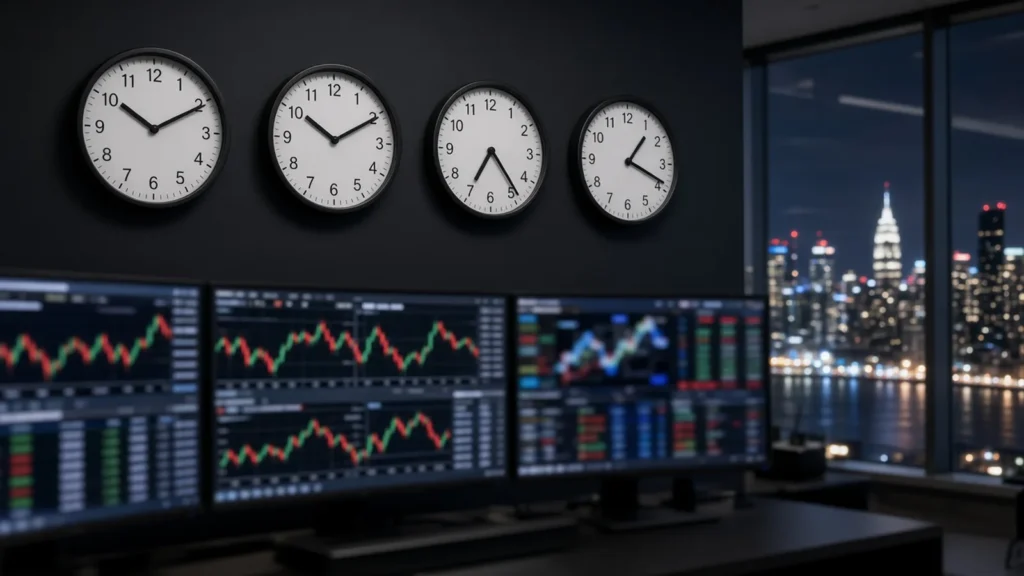
Because session times are usually published in GMT or New York time, it’s worth writing out a simple table converting them to your local time, and updating it when daylight saving time begins or ends in the U.S., Europe, Australia, or your own country, since these changes happen on different dates. Many trading platforms and broker websites also display live market-hours clocks. Knowing exactly when the London open or a major U.S. release falls in your day helps you plan sleep, work, and trading time realistically.
Frequently Asked Questions
What is the best time to trade forex?
Many traders favor the London session and the London-New York overlap for liquidity and movement, but the best time depends on your strategy, chosen pairs, and schedule.
Can I trade forex on weekends?
The interbank forex market is generally closed on weekends. Some brokers offer limited weekend products, often with wider spreads.
Why do spreads widen at certain times?
Lower liquidity, rollover periods, and news events can cause spreads to widen.
Do sessions matter for long-term traders?
Less so than for short-term traders, but entry and exit timing and news risk still matter.
Conclusion
The forex market runs around the clock during the week, but activity rises and falls as the Sydney, Tokyo, London, and New York sessions open and close. Overlaps, especially London-New York, tend to bring the highest liquidity and volatility. Choose sessions that fit your schedule, strategy, and currency pairs, keep an eye on the economic calendar, and be cautious during thin or news-driven periods. Timing alone won’t make a strategy profitable, but it can help you trade in conditions that suit your approach.
Risk warning: Trading foreign exchange (forex) and CFDs on margin carries a high level of risk and may not be suitable for all investors. Leverage can work against you as well as for you, and you can lose more than you expect, in some cases more than your initial deposit. This article is for educational purposes only and is not financial or investment advice. Consider your objectives, experience, and risk tolerance, and seek advice from an independent, licensed financial professional if needed.