Risk warning: Trading foreign exchange (forex) and CFDs on margin carries a high level of risk and may not be suitable for all investors. Leverage can work against you as well as for you, and you can lose more than you expect, in some cases more than your initial deposit. This article is for educational purposes only and is not financial or investment advice. Consider your objectives, experience, and risk tolerance, and seek advice from an independent, licensed financial professional if needed.
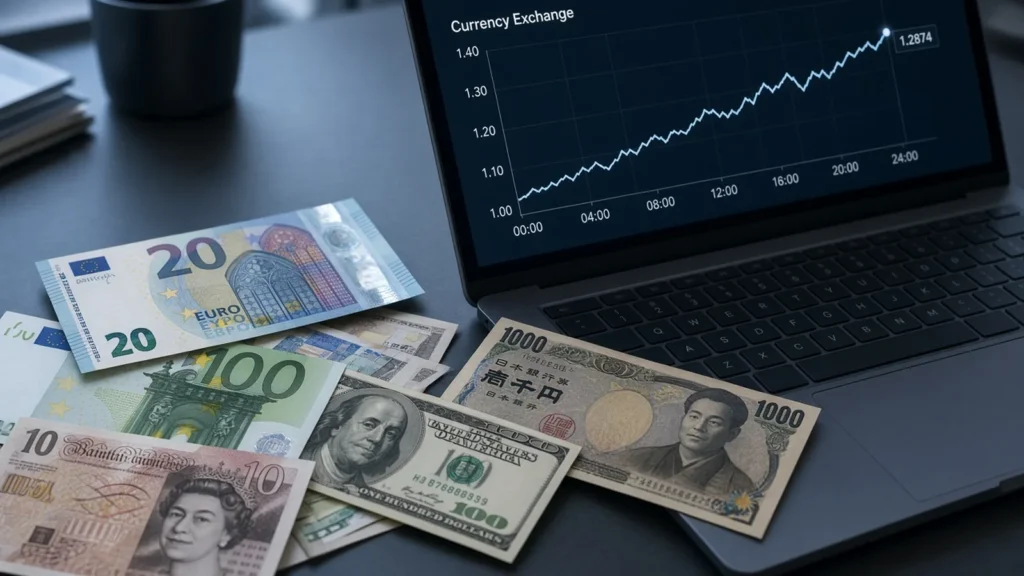
The foreign exchange market, usually called forex or FX, is where currencies are bought and sold. It’s the largest financial market in the world by trading volume, used by banks, corporations, governments, investment funds, and individual traders. Every time a company pays a foreign supplier, a tourist exchanges money, or a central bank manages reserves, the forex market is involved. For individual traders, forex is often marketed as accessible and exciting, but it’s also complex and risky, especially when leverage is involved.
This beginner’s guide explains how the forex market works, how to read currency pairs and quotes, what moves exchange rates, and what new traders should understand before risking any money.
How the Forex Market Works
Unlike stock exchanges with a central location, forex is an over-the-counter (OTC) market. Trading happens electronically through a global network of banks, brokers, and other institutions. The market operates around the clock during the business week, moving through major financial centers such as Sydney, Tokyo, London, and New York. See forex trading sessions for how activity changes during the day.
Who participates?
- Commercial and investment banks: The largest participants, trading for clients and themselves.
- Central banks: Manage monetary policy and sometimes intervene in currency markets.
- Corporations: Exchange currencies for international trade and hedge currency risk.
- Investment funds: Trade currencies as part of global strategies.
- Retail traders: Individuals trading through brokers, typically with leverage.
Understanding Currency Pairs
Currencies trade in pairs because you’re always exchanging one currency for another. Each pair has a base currency (the first) and a quote currency (the second). The price tells you how much of the quote currency equals one unit of the base currency.
For example, if EUR/USD is quoted at 1.1000, one euro costs 1.10 U.S. dollars. If you believe the euro will strengthen against the dollar, you might buy EUR/USD; if you think it will weaken, you might sell.
Types of pairs
- Major pairs: Include the U.S. dollar and another major currency, such as EUR/USD, USD/JPY, GBP/USD, USD/CHF, AUD/USD, USD/CAD, and NZD/USD. They’re typically the most liquid.
- Minor pairs (crosses): Major currencies without the U.S. dollar, such as EUR/GBP or EUR/JPY.
- Exotic pairs: A major currency paired with a currency from a smaller or emerging economy. These often have wider spreads and can be more volatile.
Reading a Forex Quote
Bid and ask
Brokers display two prices: the bid (the price at which you can sell) and the ask (the price at which you can buy). The difference is the spread, a key trading cost.
Pips
A pip is a standard unit of price movement. For most pairs, a pip is the fourth decimal place (0.0001). For pairs involving the Japanese yen, it’s usually the second decimal place (0.01). Many brokers also quote fractional pips.
Lots
Trade size is measured in lots. A standard lot is traditionally 100,000 units of the base currency, a mini lot 10,000, and a micro lot 1,000. Position size determines how much each pip movement is worth, which is central to managing risk; see forex position sizing.
What Moves Exchange Rates?
- Interest rates and central bank policy: Expectations about interest rate changes are among the most important drivers.
- Economic data: Inflation, employment, GDP growth, and trade balances influence currency demand. See how economic news affects currency markets.
- Political events and stability.
- Market sentiment and risk appetite: In uncertain times, investors may favor perceived safe-haven currencies.
- Capital flows from investment and trade.
How Retail Forex Trading Works
Most retail traders don’t exchange physical currency. Instead, they trade through brokers using spot forex or contracts for difference (CFDs, where permitted), speculating on price movements. Brokers usually offer leverage, which lets you control a large position with a smaller deposit called margin. Leverage magnifies both gains and losses; read leverage and margin explained before trading.
Going long and short
Buying a pair (going long) profits if the base currency rises relative to the quote currency. Selling (going short) profits if it falls. Because you can trade both directions, forex is sometimes described as offering opportunities in any market, but losses are equally possible in both directions.
Costs of trading
- Spreads: The difference between bid and ask.
- Commissions: Some account types charge per trade.
- Swap or rollover fees: Charged or credited for holding positions overnight, based on interest rate differences.
The Reality of Risk
Retail forex trading is difficult. Regulators in several jurisdictions require brokers to disclose the percentage of retail accounts that lose money trading CFDs, and these disclosures commonly show that a majority of retail accounts lose money. Factors include leverage, trading costs, lack of a tested strategy, and emotional decision-making. See forex trading psychology.
Getting Started Responsibly
- Learn the basics thoroughly before trading real money.
- Choose a regulated broker: See how to choose a regulated forex broker.
- Practice on a demo account to learn the platform and test strategies; see demo vs. live trading.
- Develop a written trading plan with entry rules, exit rules, and risk limits.
- Use risk management tools: Stop-loss orders and small position sizes; see stop-loss and take-profit orders.
- Only risk money you can afford to lose, after building an emergency fund.
- Keep a trading journal to learn from every trade.
- Beware of scams: See forex scams: red flags.
Common Beginner Misconceptions
- “Forex is a quick way to get rich.” Consistent profitability is rare and takes skill, discipline, and risk control.
- “High leverage means bigger profits.” It also means bigger, faster losses.
- “A strategy or signal service guarantees results.” No legitimate strategy guarantees profits.
- “More trades mean more money.” Overtrading often increases costs and losses.
Key Terms to Know
- Liquidity: How easily a pair can be traded without large price changes.
- Volatility: How much and how quickly prices move.
- Slippage: When an order executes at a different price than expected, often during fast markets.
- Margin call: A notice or automatic action when your account equity falls below required margin.
- Technical and fundamental analysis: Two main approaches to analyzing markets; see fundamental vs. technical analysis.
Frequently Asked Questions
How much money do I need to start?
Brokers may allow small deposits, but starting small doesn’t eliminate risk. Many educators suggest practicing on a demo account first and risking only a small percentage of capital on any trade.
Is forex trading legal?
In many countries, yes, through regulated brokers. Rules vary by jurisdiction, and some products such as CFDs are restricted in certain countries.
Can I trade forex part-time?
Many people do, often focusing on specific sessions. Time zone and schedule matter for choosing when to trade.
Is forex the same as investing?
Short-term leveraged currency trading is speculation and differs from long-term diversified investing.
Conclusion
Forex is the global market for exchanging currencies, driven by interest rates, economic data, and sentiment. Understanding currency pairs, quotes, pips, lots, and costs is the foundation for any further learning. Retail forex trading carries high risk, especially with leverage, and many traders lose money. If you choose to explore it, learn thoroughly, use a regulated broker, practice on a demo account, manage risk carefully, and never trade money you can’t afford to lose.
Risk warning: Trading foreign exchange (forex) and CFDs on margin carries a high level of risk and may not be suitable for all investors. Leverage can work against you as well as for you, and you can lose more than you expect, in some cases more than your initial deposit. This article is for educational purposes only and is not financial or investment advice. Consider your objectives, experience, and risk tolerance, and seek advice from an independent, licensed financial professional if needed.